The ensuing picture of the economy appears to the non-Keynesian as a sort of trick film. Everything happens in a manner that is exactly the opposite of what he is used to. It is no longer the supply of labor, but the propensity to consume that determines the volume of production; the old and oft-refuted underconsumption theories — of which Keynes's theory is no more than a replica — once more become respectable.Indeed.
Monday, April 12, 2010
L. Albert Hahn and "The Economics of Illusion" from 1956
L. Albert Hahn wrote "The Economics of Illusion" in 1956 about the Keynesian Hoax. It most surely is a hoax. He states in his introduction about Keynes' theory :
Dean Baker is a Keynesian
We all knew that. Here he responds to DeLong's critique of Baker's new book:
I don't ordinarily use BTP for addressing items that mention me or my work, but I'll make an exception in the hope of getting a good exchange going. Brad DeLong was good enough to begin a review of my book False Profits on his blog. After graciously giving me credit for recognizing the housing bubble and the dangers it posed, Brad goes on:To understand these guys, one must first wrap one's brain about two little assumptions that they make:
"But let me start by saying how I disagree with the book. I think that its story of the linkages between our current crisis and Federal Reserve policy is significantly overstated. Its argument about how excessively-low interest rates caused the housing bubble is exaggerated. I think that its belief that the Federal Reserve could have taken much more action to curb the housing bubble while is underway is also exaggerated, and does not recognize the very real constraints that the Federal Reserve works under and all but ignores the costs of austerity. And it overstates the strength of the links between the housing bubble and the housing crash on the one hand and our current situation of macroeconomic despair on the other."
Okay, let's go point by point.
1)"Its argument about how excessively-low interest rates caused the housing bubble is exaggerated."
That doesn't sound like my book. I argued that the weak economy caused by the crash of the stock bubble demanded stimulatory policy. Low interest rates were the right policy -- we needed them to recover from the stock bubble. However, this did create an environment that was conducive to the growth of bubbles. If the Fed had kept the Federal Funds rate at 5.0 percent I feel pretty confident in saying that we would not have had a housing bubble -- very high unemployment, but no housing bubble.
2) "I think that its belief that the Federal Reserve could have taken much more action to curb the housing bubble while is underway is also exaggerated, and does not recognize the very real constraints that the Federal Reserve works under and all but ignores the costs of austerity."
Let's see, my policy prescription was to have every last staffer at the Fed devoting all of his/her time to documenting the evidence for the bubble and the dangers it would cause to the economy. I would have had Alan Greenspan use his congressional testimonies and other public speaking engagements to warn of the risks of the bubble. This doesn't mean mumbling "irrational exuberance," it means carefully showing with charts and graphs how house prices have followed an unprecedented and unsustainable path. He also should have warned explicitly what would have happened to the banks that had made big bets on the bubble when it burst.
In addition, they should have made full use of their regulatory power (including working with other regulators) to crack down on the issuance and securitization of junk mortgages. The "who could have known?" line is crap. These loans were being issued by the million, there is no way Greenspan could not have known about them.
Would this have worked? Brad for some reason is very confident it would not have. It certainly would have been nice if the Fed had tried (what was more important?), then we would both know for sure.
As a last resort I would have raised interest rates. I hate to throw people out of work (except Wall Street bankers and economists), but it would have been better to preemptively burst the bubble rather than let it run its course and be where we are today.
3) "it overstates the strength of the links between the housing bubble and the housing crash on the one hand and our current situation of macroeconomic despair on the other."
There is a pretty direct line from the falloff in residential construction due to the overbuilding caused by the bubble, the falloff in non-residential construction due to the overbuilding caused by the bubble, and the falloff in consumption as a result of the lost housing bubble wealth and where the economy is today. I don't see much obvious room for a financial crisis in this explanation. The crisis may have brought the downturn on more quickly, but it seems that the basic problem is the loss of the demand generated by the bubble.
I have a strong ally in this argument: Spain. Spain did not have a financial crisis, but it now has 19 percent unemployment, the highest in the EU. The explanation is that Spain had a really huge housing bubble. It is not easy to find new sources of demand to replace 8-10 percentage points of GDP.
--Dean Baker
1. Keynesian economics is primarily a theory designed to explain how market economies can remain persistently depressed (so claims Krugman here).Both of these assumptions are false. "Market economies" don't remain persistently depressed and neither Baker, DeLong nor Krugman are sufficiently omniscient to allow them to overcome the need for free-market pricing. You know, the little problem of "socialist calculation".
2. They are a lot smarter than the rest of us and have a duty and a right to treat us like rats in their maze.
Paul Krugman the self-hating Austrian
Krugman is just a self hating Austrian. He dimly realizes that money dilution causes problems. But in his little totalitarian "I'm smarter than the masses" mind, those problems can and must be solved by the BIG NANNY Mary Poppins, not by the market and an elimination of money dilution.
As Krugman and the Keynesians dimly take note of the mess caused by money dilution, they nevertheless attribute the malinvestments that invariably occur therefrom to laissez faire and the free market. Thus, if the Fed and the banks lend money created out of thin air while the borrowers of that new fiat money can still spend/invest that new money however they please, that system must be called "laissez faire" according to Krugman.
This is what we are up against: Fraud ab initio even at the definition stage of the debate by Krugman and his minions.
As Krugman and the Keynesians dimly take note of the mess caused by money dilution, they nevertheless attribute the malinvestments that invariably occur therefrom to laissez faire and the free market. Thus, if the Fed and the banks lend money created out of thin air while the borrowers of that new fiat money can still spend/invest that new money however they please, that system must be called "laissez faire" according to Krugman.
This is what we are up against: Fraud ab initio even at the definition stage of the debate by Krugman and his minions.
Saturday, April 10, 2010
Liars, scumbags, Krugman, Blodget and Yahoo Finance (excuse the redundancy) demand that savers be wiped out
Can you believe these guys?
Everyone thinks the Fed's job is to fight inflation, but right now the Fed is actually doing everything it can to cause inflation. Why? It part to help the economy get cranking again. Inflation provides an incentive for people to spend cash rather than saving it, because if they save it, the cash will lose value rapidly.
Inflation also helps solve another problem, though--our debt problem. The more inflation we have, the less our dollars will be worth. Because our debts are based on a specific number of dollars and not a specific value, the less our dollars are worth, the easier it will be for us to pay off our debts.
(Imagine owing someone 100 Zimbabwe dollars at a time when the currency is collapsing. If you wait a week, the value of the Zimbabwe dollar will have collapsed, and you'll be able to pay off your 100 Zimbabwe-dollar debt with currency that is only worth half as much as it was the week before).
The Fed can't admit that one reason it wants high inflation is to reduce the real burden of our debt, but you can bet that that's one of its objectives. What's more, says Nobel-winning economist Paul Krugman, inflation should be one of the Fed's objectives. Because that's how we've gotten out from under debt burdens in the past.
Here's Krugman:Then we get "banned for life" fraudster Henry Blodget calling for wiping out of the savings of savers and those on fixed incomes:
So how did the U.S. government manage to pay off its [World War 2] wartime debt? Actually, it didn’t. At the end of 1946, the federal government owed $271 billion; by the end of 1956 that figure had risen slightly, to $274 billion. The ratio of debt to G.D.P. fell not because debt went down, but because G.D.P. went up, roughly doubling in dollar terms over the course of a decade.In other words, after World War 2, we didn't "pay down" our debt. We grew into it.
And, importantly, this growth came from a combination of real growth AND inflation:
The rise in G.D.P. in dollar terms was almost equally the result of economic growth and inflation, with both real G.D.P. and the overall level of prices rising about 40 percent from 1946 to 1956.
So inflation is an important tool in getting us out of this mess. It's painful and unfair--those who have been responsible and saved money will pay the price for those who borrowed money, racked up huge debts, and spent more than they could afford. But it's what the Fed is (quietly) aiming for.
Monday, October 12, 2009
Bob on Keynes
Do we agree with Krugman on what it is exactly that Keynesians claim:
I agree with Krugman as to what it is that Keynesian economics concerns. I totally dispute the allegation that market economies remain persistently depressed absent government interference and I dispute the allegation that Keynesian policies cure depressions. Economic panics and recessions are caused by artificial credit expansion caused either by fractional reserve banking and/or central banking.
See Chapter 2, “End the Fed” for an outline of this topic.
See chapters 1, 2 and 3 of “Money, Bank Credit and Economic Cycles” by Jesus Huerta de Soto for the full account.
Thus, the banking cartel created the Fed so that it could create legal counterfeit money to bail out its inherently risky fractional reserve banking. It was also handy to have the Fed around to help fund the unnecessary entrance of the U.S. in WWI.
The inflationary dislocations caused by the Fed and the War resulted in the depression of 1920, the one you never hear about (because it totally disproves the Keynesians). No Keynesian type solutions were tried and the crisis was over quickly.
Between the second quarter of 1920 to the third quarter of 1921, wholesale prices fell 44%. Factory employment and industrial production fell 30%. The Fed raised the discount rate from 4% to 7% and then back to 4%. The Harding government did basically nothing in the way of so called Keynesian stimulus. Harding specifically and intentionally did nothing to interfere with falling wages and prices. Further, Federal spending declined from $6.3 billion in 1920 to $5 billion in 1921 and $3.3 billion in 1922. Tax rates, meanwhile, were slashed—for every income group. And over the course of the 1920s, the national debt was reduced by one third. The crisis was over quickly. Thomas Woods has an interesting article and excellent video on this topic.
The 1920 depression demonstrates that even after a horrible inflationary dislocation caused by the Fed, prices and wages can and do readjust fairly quickly without the need of government interference.
The Fed then increased the money supply by 2/3, causing the 1929 crash.
Hoover wasn’t a Hooverite. Hoover behaved as a textbook Keynesian after the stock-market crash. He immediately cut income tax rates by one percentage point (applicable to the 1929 tax year) and began ratcheting up federal spending, increasing it 42 percent from fiscal year (FY) 1930 to FY 1932. In 1931, the New York fed had lowered interest rates to 1.5 %.
Look at his last two budgets. In 1932, receipts were $1.9 billion and expenditures were $4.7 billion. In 1933, receipts were $2 billion and expenditures were $2.6 billion. He urged business to keep wages high which helped cause the unprecedented unemployment.
Hoover then decided to raise tax rates. Check the historical tax rates here. Note how the rates rise to ridiculous levels starting in 1932 under Hoover and keep going up. No wonder the depression lasted until FDR died and Congress slashed spending by 2/3 after WW II.
So along comes Keynes in 1936. The 1920 depression showed that the market can and will readjust all by itself to rid itself of malinvestment and dislocations caused by Fed monetary dilution. The 1929 depression showed that intervention prolongs depressions. Keynes writes in his "General Theory" (without any historical reference or proof whatsoever) that the market cannot self adjust from a depressions (Keynes ignores the fact that it was the central bank's monetary diliution that caused the problem in the first place). He then states that it would be better if the central bank would simply just dilute the money supply so that there might be UNIFORM wage reductions to cure unemployment:
Keynes himself sounds exactly like Prof. Hayek describing Keynesianism.
Keynesian economics is primarily a theory designed to explain how market economies can remain persistently depressed.
I agree with Krugman as to what it is that Keynesian economics concerns. I totally dispute the allegation that market economies remain persistently depressed absent government interference and I dispute the allegation that Keynesian policies cure depressions. Economic panics and recessions are caused by artificial credit expansion caused either by fractional reserve banking and/or central banking.
Pre Fed panics were caused because the banks combined the money warehousing function with the loan function. The institution of fractional reserves mixes these two functions, such that warehousing becomes a source for lending. The bank loans out money that has been warehoused and stands ready to use in checking accounts or other forms of checkable deposits, and that newly loaned money is deposited yet again in checkable deposits. It is loaned out again and deposited, with each depositor treating the loan money as an asset on the books. In this way, fractional reserves create new money, pyramiding it on top of a fraction of old deposits. Depending on reserve ratios and banking practices, an initial deposit of $1,000, thanks to this "money multiplier," turns into deposits of $10,000. From the depositor point of view, this system has created certain illusions. As customers of the bank, we tend to believe that we can have both perfect security for our money, drawing on it whenever we want and never expecting it not to be there, while still earning a regular rate of return on that same money. In a true free market, however, there tends to be a tradeoff: you can enjoy the service of a money warehouse or you can loan your money to the bank and hope for a return on your investment. You can't usually have both. The Fed was created by the banking cartel as a back-up to this fractional-reserve system with a promise of endless bailouts and money creation, attempts to keep the illusion going.
Even with a government-guaranteed system of fractional reserves, the system is always vulnerable to collapse at the right moments, namely, when all depositors come asking for their money in the course of a run (think of the scene in It's a Wonderful Life). The whole history of modern banking legislation and reform can be seen as an elaborate attempt to patch the holes in this leaking boat.
See Chapter 2, “End the Fed” for an outline of this topic.
See chapters 1, 2 and 3 of “Money, Bank Credit and Economic Cycles” by Jesus Huerta de Soto for the full account.
Thus, the banking cartel created the Fed so that it could create legal counterfeit money to bail out its inherently risky fractional reserve banking. It was also handy to have the Fed around to help fund the unnecessary entrance of the U.S. in WWI.
The inflationary dislocations caused by the Fed and the War resulted in the depression of 1920, the one you never hear about (because it totally disproves the Keynesians). No Keynesian type solutions were tried and the crisis was over quickly.
Between the second quarter of 1920 to the third quarter of 1921, wholesale prices fell 44%. Factory employment and industrial production fell 30%. The Fed raised the discount rate from 4% to 7% and then back to 4%. The Harding government did basically nothing in the way of so called Keynesian stimulus. Harding specifically and intentionally did nothing to interfere with falling wages and prices. Further, Federal spending declined from $6.3 billion in 1920 to $5 billion in 1921 and $3.3 billion in 1922. Tax rates, meanwhile, were slashed—for every income group. And over the course of the 1920s, the national debt was reduced by one third. The crisis was over quickly. Thomas Woods has an interesting article and excellent video on this topic.
The 1920 depression demonstrates that even after a horrible inflationary dislocation caused by the Fed, prices and wages can and do readjust fairly quickly without the need of government interference.
The Fed then increased the money supply by 2/3, causing the 1929 crash.
Hoover wasn’t a Hooverite. Hoover behaved as a textbook Keynesian after the stock-market crash. He immediately cut income tax rates by one percentage point (applicable to the 1929 tax year) and began ratcheting up federal spending, increasing it 42 percent from fiscal year (FY) 1930 to FY 1932. In 1931, the New York fed had lowered interest rates to 1.5 %.
Look at his last two budgets. In 1932, receipts were $1.9 billion and expenditures were $4.7 billion. In 1933, receipts were $2 billion and expenditures were $2.6 billion. He urged business to keep wages high which helped cause the unprecedented unemployment.
Hoover then decided to raise tax rates. Check the historical tax rates here. Note how the rates rise to ridiculous levels starting in 1932 under Hoover and keep going up. No wonder the depression lasted until FDR died and Congress slashed spending by 2/3 after WW II.
So along comes Keynes in 1936. The 1920 depression showed that the market can and will readjust all by itself to rid itself of malinvestment and dislocations caused by Fed monetary dilution. The 1929 depression showed that intervention prolongs depressions. Keynes writes in his "General Theory" (without any historical reference or proof whatsoever) that the market cannot self adjust from a depressions (Keynes ignores the fact that it was the central bank's monetary diliution that caused the problem in the first place). He then states that it would be better if the central bank would simply just dilute the money supply so that there might be UNIFORM wage reductions to cure unemployment:
(i) Except in a socialised community where wage-policy is settled by decree, there is no means of securing uniform wage reductions for every class of labour. The result can only be brought about by a series of gradual, irregular changes, justifiable on no criterion of social justice or economic expedience, and probably completed only after wasteful and disastrous struggles, [when did this happen????] where those in the weakest bargaining position will suffer relatively to the rest. A change in the quantity of money, on the other hand, is already within the power of most governments by open-market policy or analogous measures. Having regard to human nature and our institutions, it can only be a foolish person who would prefer a flexible wage policy to a flexible money policy, unless he can point to advantages from the former which are not obtainable from the latter. Moreover, other things being equal, a method which it is comparatively easy to apply should be deemed preferable to a method which is probably so difficult as to be impracticable…….
(ii)…..If important classes are to have their remuneration fixed in terms of money in any case, social justice and social expediency are best served if the remunerations of all factors are somewhat inflexible in terms of money. Having regard to the large groups of incomes which are comparatively inflexible in terms of money, it can only be an unjust person who would prefer a flexible wage policy to a flexible money policy, unless he can point to advantages from the former which are not obtainable from the latter.
(iii) The method of increasing the quantity of money in terms of wage-units by decreasing the wage-unit increases proportionately the burden of debt; whereas the method of producing the same result by increasing the quantity of money whilst leaving the wage-unit unchanged has the opposite effect. Having regard to the excessive burden of many types of debt, it can only be an inexperienced person who would prefer the former. Pages 268-269
Keynes himself sounds exactly like Prof. Hayek describing Keynesianism.
Saturday, December 6, 2008
Brady Bunch Gun Campaign rankings
The Brady Campaign to Prevent Gun Violence has rankings and ratings of how much gun fascism exists in each state--the more fascism, the higher the ranking and rating. Just scroll down and click on each state for the results.
Let's see how they ranked North Dakota. Pretty bad. North Dakota is ranked 44th out of 50 states and gets 4 out of a possible 100 points because rifles, shotguns and handguns are so easy to obtain and use there. A perfect score of 100 represents North Korea.
North Dakota must be a gun killer's paradise. Let's check US Crime Statistics. North Dakota has a murder and nonnegligent manslaughter rate of 1.9 per 100,000.
The Canadian province of Manitoba is just north of North Dakota. Everybody knows that Canada is a sheer paradise and does not allow common folk to have handguns. This must totally eliminate crime, especially murder, right? Let's check Canadian Crime Statististics [click here]. According to the official Canadian government statistics, Manitoba had a murder rate of 5.2 per 100,000.
Even worse, the new Canadian Inuit [f.k.a. "Eskimos"] territory of Nunavut has a murder rate of 22.5 per 100,000 [click here]
How can that be? Could the Brady Bunch be WRONG about guns??
Let's see how they ranked North Dakota. Pretty bad. North Dakota is ranked 44th out of 50 states and gets 4 out of a possible 100 points because rifles, shotguns and handguns are so easy to obtain and use there. A perfect score of 100 represents North Korea.
North Dakota must be a gun killer's paradise. Let's check US Crime Statistics. North Dakota has a murder and nonnegligent manslaughter rate of 1.9 per 100,000.
The Canadian province of Manitoba is just north of North Dakota. Everybody knows that Canada is a sheer paradise and does not allow common folk to have handguns. This must totally eliminate crime, especially murder, right? Let's check Canadian Crime Statististics [click here]. According to the official Canadian government statistics, Manitoba had a murder rate of 5.2 per 100,000.
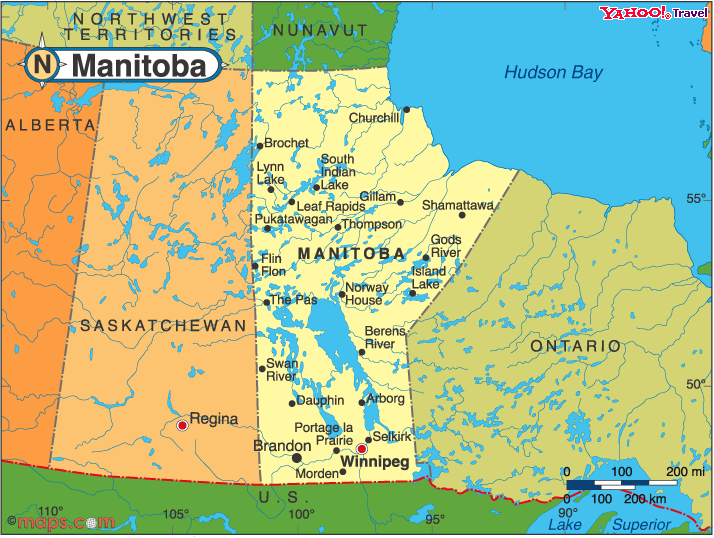

Even worse, the new Canadian Inuit [f.k.a. "Eskimos"] territory of Nunavut has a murder rate of 22.5 per 100,000 [click here]

How can that be? Could the Brady Bunch be WRONG about guns??
Thursday, December 4, 2008
Wednesday, December 3, 2008
FREE PLAXICO BURRESS - and the hell with Bloomberg and ESPN
Johnny Kramer has published an excellent article at LRC about the persecution of Plaxico Burress. Considering that we are in the midst of the greatest theft of wealth and plunder in human history, the corporate bailouts, a government induced and prolonged depression and horrendous gang crime caused by prohibition, this is a rather bizarre event upon which to focus the 24 hour news hysteria. We now have the despicable and evil Mayor Bloomberg calling for Plaxico's blood while being cheered on by the numbnuts on ESPN:
Unfortunately for Plaxico, this sounds like the perfect storm of people who, on general principles, would want his hide: racist red-staters and the fascist church ladies of the left.
[UPDATE] Reason has an excellent article here on Plaxico:
Tiki should have slapped that that little weenie Costas in the face.
"Bloomberg has made his war on illegal guns a signature issue. He also had harsh words for the hospital where Burress was treated, New York Presbyterian Hospital/Weill Cornell Medical Center. He said hospital management should be charged for failing to report the incident, and that the hospital workers involved should be fired.
"'It is just an outrage that the hospital didn't do what they are legally required to do,' he said. 'It's a lame excuse that they didn't know – this is a world-class hospital in a city where we all know what goes on in the streets of our city, and we all should be working together to get guns off the streets.'
Unfortunately for Plaxico, this sounds like the perfect storm of people who, on general principles, would want his hide: racist red-staters and the fascist church ladies of the left.
[UPDATE] Reason has an excellent article here on Plaxico:
But Burress' teammate Steve Smith also lives in the public domain. Several days before the mishap at the club, Smith was robbed at gunpoint outside of his home in Clifton, New Jersey. Former Giants teammate and current NBC commentator Tiki Barber discussed the two crimes on Sunday Night Football, explaining that Burress' foolish act may have been rational, if not completely appropriate, given the dangers that NFL players such as Smith have faced.Looking back at recent gun-related tragedies that have struck the NFL, Barber continued, "We all remember [slain Denver Broncos cornerback] Derrent Willams from a couple of years ago and even last year, and ironically [Washington Redskins safety] Sean Taylor was honored at this game, and he was [fatally] attacked at his home. A lot of people believe that if [Taylor] had a gun, he wouldn't be dead right now." Barber failed to mention an attack earlier this year which left Jacksonville Jaguars offensive tackle Richard Collier paraplegic and without his left leg due to amputation..
Such an oversight is understandable given the surprisingly high number of similar incidents, but even those numbers are not enough to convince longtime NBC Sports broadcaster Bob Costas that protecting oneself with a handgun may be a rational decision. After Barber finished recalling the recently murdered NFL players, Costas launched into a harangue against the ludicrous notion of self-defense, demanding that Tiki provide a singular instance where a player had saved his own life or averted disaster with a handgun. While Barber agreed with Costas that Burress' actions were
irresponsible, he insisted that guns are common to many players, given the violent circumstances he described and the violent neighborhoods many of the NFL's athletes grew up in. They really do rely on guns for self-defense, Barber argued. And it doesn't take any great leap of logic to understand why these athletes don't broadcast the fact.
Such an admission in Washington, D.C., San Francisco, or Chicago—all cities with NFL franchises—could land a player in jail, in addition to the fines and suspensions handed down by the league (not to mention local politicians publicly chiding them as if they were irresponsible children). Leaving aside the wisdom of Burress's actions, the criminal penalty he faces, if convicted, is inflexible and unfair. No judge in the state of New York, no matter what evidence is given, no matter how sympathetic the judge may be to a man whose teammate had a gun pointed at his head less than a week before, no matter what damage lengthy incarceration may do to the man's career, family, and reputation, will be able to lessen the sentence accompanying a guilty verdict.
Tiki should have slapped that that little weenie Costas in the face.
Sunday, November 30, 2008
Thursday, November 27, 2008
1989 Michigan Libertarian Party Panel Discussion - Part 1 of 4
Discussing the future of freedom in 1989:
Murray Rothbard
Lew Rockwell
Richard Ebeling
Larry Reed
Joe Bast
Charles Van Eaton


Murray Rothbard video from Michigan Libertarian Party Convention 1989
I have the entire 2 hour panel discussion and Murray's great dinner speech. These will be posted in the future.
The corrupt MSM will kill us all

The ignorance and mendacity of the MSM always astonishes me. During my campaign for the Michigan Supreme Court for the November 4, 2008 election, I tended to keep up with the biased and ignorant reporting of the Detroit News and Free Press more than usual. What struck me was that while EVERY political article was predictably written in a totally biased manner by an Epsilon-Minus Semi-Moron, the majority of the on-line comments that followed each article tended to be highly critical of the article from a well-written libertarian or conservative position by an average of 7 out of 10comments. Thus, these newspapers must know how much they are dispised by their own on-line readers.
However, nothing ever changes. Between April and September 2008, the Detroit News lost 10% and the Free Press 6% of its readership. That is simply amazing.
The tragedy of all this is that most people do not have the time or inclination to hunt for the truth about current events and history and are merely going to soak up the usual lies and distortions of the MSM media.
However, nothing ever changes. Between April and September 2008, the Detroit News lost 10% and the Free Press 6% of its readership. That is simply amazing.
The tragedy of all this is that most people do not have the time or inclination to hunt for the truth about current events and history and are merely going to soak up the usual lies and distortions of the MSM media.
Friday, November 7, 2008
There will be no recovery until EVERYONE understands the insidious FEDERAL RESERVE

Not too long ago, our paper money was a receipt for gold or silver. Check out this 1905 gold certificate, above. On the other hand, our current dollar is a receipt for nothing [click for larger view]:

Legal money is a claim on resources. It is both immoral and unconstitutional to have the government or the FED creating fiat money (claims on resources) out of thin air, which is its primary purpose. This necessarily dilutes the value of the existing money stock and thus fraudulently transfers wealth to the receivers of the new money from everyone else holding the old money. When you hear some politician or nitwit in the media calling for an “injection of liquidity”, they are really calling for more money dilution (although they would never admit this).
Those spending the new money have neither created nor do they possess anything of value with which to trade. In spending the new money, the holders of the new money are able to siphon away through purchase the valuable goods and services which could only be obtained by those holding the old money absent the fraudulent creation of the new diluted money which artificially increases demand for EVERYTHING and raises prices. Further, this constant monetary dilution is the sole cause of inflation. Inflation is impossible when money is backed by gold and silver because money backed by precious metals cannot be created out of thin air. Money should be the primary store of value. Houses should not be the primary store of value.
The FED’s money dilution inevitably creates a game of financial musical chairs with everyone trying to find value in the face of constantly diluted dollars. More egregiously, it effectively destroys the normal price system which is how economic information is transmitted in the market. Finally, the FED”s monetary dilution causes the boom and bust cycle by drawing investment into types of production that are unsustainable absent continuing monetary dilution. Indeed, these unsustainable lines of production will eventually fail even with additional money dilution. This is the situation in which we find ourselves today. Indeed, as the entire planet suddenly discovers that everyone is much poorer than previously realized, what the hell good will be an "injection" of diluted dollars into "the economy"? [HELLO MICHIGAN!!! AUTO FACTORIES AND AUTO PURCHASES ARE IMPACTED BY MONEY DILUTION TOO!! LONG TERM ECONOMIC PLANNING BECOMES IMPOSSIBLE!]
As such, in a regime with constantly diluted dollars, most capital gains are illusory, but are nevertheless taxable because there is no indexing of capital gains for inflation. THIS ISN'T THAT COMPLICATED. However, it appears to me that most people would rather live in a cold, muddy refugee camp in a cardboard box than spend the 8 minutes it might take to understand what the FED is doing to their lives.
Those spending the new money have neither created nor do they possess anything of value with which to trade. In spending the new money, the holders of the new money are able to siphon away through purchase the valuable goods and services which could only be obtained by those holding the old money absent the fraudulent creation of the new diluted money which artificially increases demand for EVERYTHING and raises prices. Further, this constant monetary dilution is the sole cause of inflation. Inflation is impossible when money is backed by gold and silver because money backed by precious metals cannot be created out of thin air. Money should be the primary store of value. Houses should not be the primary store of value.
The FED’s money dilution inevitably creates a game of financial musical chairs with everyone trying to find value in the face of constantly diluted dollars. More egregiously, it effectively destroys the normal price system which is how economic information is transmitted in the market. Finally, the FED”s monetary dilution causes the boom and bust cycle by drawing investment into types of production that are unsustainable absent continuing monetary dilution. Indeed, these unsustainable lines of production will eventually fail even with additional money dilution. This is the situation in which we find ourselves today. Indeed, as the entire planet suddenly discovers that everyone is much poorer than previously realized, what the hell good will be an "injection" of diluted dollars into "the economy"? [HELLO MICHIGAN!!! AUTO FACTORIES AND AUTO PURCHASES ARE IMPACTED BY MONEY DILUTION TOO!! LONG TERM ECONOMIC PLANNING BECOMES IMPOSSIBLE!]
As such, in a regime with constantly diluted dollars, most capital gains are illusory, but are nevertheless taxable because there is no indexing of capital gains for inflation. THIS ISN'T THAT COMPLICATED. However, it appears to me that most people would rather live in a cold, muddy refugee camp in a cardboard box than spend the 8 minutes it might take to understand what the FED is doing to their lives.
Monday, May 26, 2008
Global Warming and the housing boom/bust
I am always amazed that the government simultaneously encourages sprawl with its fiat money binges, highway construction, Fannie Mae mortgage subsidies and home mortgage deductions and then constantly whines and hectors about it, proposing new draconian regulation to rein it in. Moronic global warming regulation comes to mind.
I suppose that this is not surprising. The government then gets to bully us both ways.
I suppose that this is not surprising. The government then gets to bully us both ways.
Subscribe to:
Posts (Atom)